
Rideshare crashes are not handled exactly like ordinary car accident cases. That is the part many people miss. If an Uber or Lyft driver causes a crash in Los Angeles, the biggest legal question is not always just who was at fault. It is also what insurance period applied at the exact moment of the crash. That single detail can affect which policy responds, how much coverage is available, and how hard the insurer fights the claim.
That is why rideshare accidents in Los Angeles 2026 is a strong topic right now. California’s insurance rules for transportation network companies have layers, and recent law changes have made some parts of the coverage picture even more important. If you are injured as a passenger, another driver, a pedestrian, or a cyclist in a rideshare-related crash, you need to understand that Uber and Lyft claims do not move on a one-size-fits-all insurance model.
This post fits naturally with your current blog. If you are dealing with a collision right now, it also helps to review AI Dashcams and Digital Evidence: How Technology Is Changing Car Accident Claims in Los Angeles, California Raises Auto Insurance Minimums in 2025: What Los Angeles Drivers Must Know, and Distracted Driving Remains California’s Leading Cause of Crashes in 2025.
Why rideshare accident claims are more complicated than standard crashes
In a normal Los Angeles car accident case, the insurance structure is usually straightforward. One driver caused the crash, and that driver’s insurer becomes the first major target. In a rideshare case, there may be multiple policies in play at once. The Uber or Lyft driver may have personal coverage, rideshare-period coverage, and app-based commercial coverage. The rideshare company may also have obligations depending on what the driver was doing when the crash happened.
That means a rideshare case often turns on timeline evidence. Was the driver offline? Logged in and waiting for a request? On the way to a pickup? Carrying a passenger? Each stage can change the insurance analysis. If the wrong period is assumed, a victim can end up dealing with delays, denials, or a lower-value case than the facts actually support.
The three insurance periods that matter most
Period 0: App off
If the driver was not using the rideshare app at all, this usually looks more like a standard car accident case. The driver’s personal auto policy is generally the starting point. Uber or Lyft coverage is not normally the main issue here because the driver was not actively engaged in rideshare work.
Period 1: App on, waiting for a ride request
This is where things start to get more complicated. The driver is available for rides, but no passenger has been accepted yet. During this period, California requires lower primary limits than during an active ride, plus additional excess coverage. That can still matter a lot in a serious crash, but it is not the same as full on-trip coverage.
Periods 2 and 3: Ride accepted or passenger in the car
Once the driver accepts a ride and while the ride is in progress, California requires much stronger TNC coverage. This is the period most people think of when they hear that Uber or Lyft carries a large commercial policy. However, even here, coverage questions can still arise over fault, comparative negligence, and uninsured or underinsured losses.
Why the 2026 insurance rules matter more now
California’s rideshare insurance framework is still layered, but one recent change makes it especially important to review the exact policy issues in serious injury cases. The state changed the uninsured and underinsured motorist coverage requirement that applies while a passenger is in the vehicle. That matters because many victims assume the biggest policy is always available in every direction for every kind of loss. That is not how these cases work.
For example, a passenger may be injured when another driver with low coverage hits the Uber or Lyft vehicle. In that situation, the available uninsured or underinsured motorist protection can become extremely important. If the victim assumes old limits still apply, they may misunderstand the real insurance landscape from the start.
This is exactly why rideshare accidents in Los Angeles 2026 deserves a dedicated article. The law is not standing still, and insurance companies do not usually rush to explain coverage layers in a way that helps injured people.
Who may have a claim after a rideshare crash?
Rideshare accident claims are not limited to passengers. A claim may involve:
- the Uber or Lyft passenger inside the vehicle,
- another driver hit by the rideshare vehicle,
- a pedestrian or cyclist,
- the rideshare driver, depending on fault and coverage,
- multiple injured parties from a chain-reaction crash.
In dense Los Angeles traffic, these cases can turn into multi-party disputes fast. A rear-end crash, unsafe lane change, distracted turn, or freeway merge can involve more than one negligent actor. The rideshare driver may be partly at fault. Another vehicle may be primarily at fault. A third party may have contributed by speeding, cutting across lanes, or driving distracted. The coverage stack and liability fight can become messy quickly.
What evidence can strengthen a Los Angeles rideshare claim?
App data and ride status
This is one of the most important categories in the whole case. If the driver was working, the app timeline helps establish which insurance period applied. Pickup acceptance, route status, passenger pickup timing, and trip completion records can all matter.
Dashcam and video footage

Camera evidence is powerful in rideshare cases because it can show vehicle position, traffic conditions, distraction, braking, and impact timing. That is why your existing post on AI dashcams is a strong internal companion to this topic.
Phone and device records
If the crash involved distraction, app interaction, navigation changes, or call activity, digital evidence may help explain why the driver failed to react.
Witness statements
Passengers, nearby drivers, pedestrians, and business employees may have seen whether the rideshare driver was speeding, turning unsafely, or looking away from the road.
Medical records
Like any injury claim, treatment records connect the crash to the injuries and help prove what the collision actually cost you. Without solid medical documentation, even a strong liability case can lose value.
Common rideshare crash scenarios in Los Angeles
- Pickup and drop-off collisions: sudden stops, unsafe curbside maneuvers, and distracted scanning for riders.
- Rear-end crashes: especially in stop-and-go traffic when drivers are juggling the app and the road.
- Intersection crashes: rushed turns, signal violations, or late braking.
- Dooring or curbside passenger injuries: when riders enter or exit in unsafe traffic conditions.
- Hit-and-run situations: where the rideshare passenger is left sorting out multiple insurers and incomplete facts.
If your case overlaps with a fleeing driver or disputed fault, it may also make sense to connect this topic to your blog’s hit-and-run and mistake-avoidance content.
What to do after a rideshare crash
- Get medical care right away. Your health comes first, and treatment records matter.
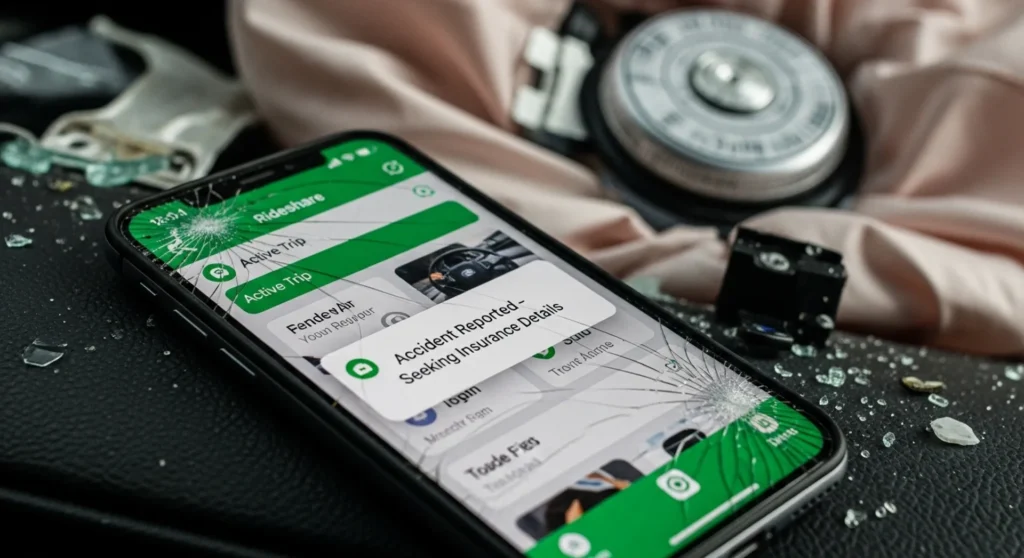
- Take screenshots of the ride. Preserve the app, trip receipt, driver profile, route, and timestamps.
- Photograph the scene. Include vehicle damage, roadway conditions, license plates, and visible injuries.
- Get names and contact details. Passengers and bystanders may become critical witnesses.
- Report the crash through the app and to law enforcement. Do not rely on one report alone.
- Avoid broad recorded statements early. Keep things factual and do not guess about fault.
- Talk to a lawyer before coverage arguments harden. Rideshare insurers move fast when they see a chance to narrow the claim.
Why insurance companies push back so hard in these cases
Rideshare claims often involve larger policies than ordinary crashes, which means insurers have stronger incentives to narrow fault, reduce injury value, or argue that another policy should pay first. They may dispute which period applied, claim the driver was no longer on a ride, argue that another driver caused the crash, or minimize the severity of your injuries.
That is why timing and documentation matter so much. The better your evidence, the harder it becomes for the insurer to reshape the facts after the crash.
External resource
For official background on California rideshare insurance rules, see the California Public Utilities Commission’s TNC insurance requirements. You can also review the California Department of Insurance ridesharing page.
Final thoughts
Uber and Lyft accidents in Los Angeles are different because the claim is not just about the crash. It is also about the app status, the insurance period, the available policy layers, and the evidence needed to prove which coverage actually applies. In 2026, that matters even more because California’s rideshare insurance rules are not static, and some protections are narrower than many riders expect.
If you were injured in a rideshare crash, do not assume the insurance answer is obvious. Preserve the ride data, document the scene, get treatment, and move quickly before the coverage dispute starts defining the case for you.