
Los Angeles Vision Zero accident claims 2026 are becoming more important as the city continues to deal with serious traffic injuries, pedestrian crashes, speeding, and dangerous corridors. Vision Zero was built around a simple goal: reduce traffic deaths and severe injuries. For crash victims, that goal can also raise a practical legal question. Can street-safety data help explain why an accident happened?
The answer depends on the facts. Vision Zero data does not automatically prove a driver, city agency, rideshare company, or property owner caused a crash. However, it can help show why a street, intersection, or corridor needed extra caution. It may also support an argument that speed, poor visibility, weak design, or unsafe driver behavior played a major role.
In 2026, Los Angeles is paying close attention to speed safety systems, high-risk roads, school areas, senior zones, pedestrian crossings, and crash-heavy corridors. That makes this topic useful for injured drivers, passengers, pedestrians, cyclists, and families who need to understand how evidence can shape a claim.
This guide explains how Los Angeles Vision Zero accident claims 2026 may involve speed, camera evidence, dangerous road design, medical records, insurance disputes, and digital proof after a serious crash.
Why Vision Zero Still Matters In Los Angeles Crash Claims
Los Angeles traffic creates daily risk. Drivers rush through crowded streets. Pedestrians cross wide roads. Rideshare vehicles stop suddenly. Delivery drivers block lanes. School traffic creates morning and afternoon pressure. A single mistake can cause a serious injury.
Vision Zero matters because it focuses attention on patterns, not only isolated crashes. If a street has repeated speeding problems, poor visibility, or a history of serious collisions, that background may help explain why a crash was predictable. It may also show why a driver should have used more care.
For example, a crash near a school is different from a crash on an empty road. A driver near a school should expect children, parents, buses, and sudden crossings. Your site already covers this issue in Los Angeles School Zone Accident Claims in 2026.
LADOT’s speed safety program is also relevant. The city says speeding is one of the leading causes of serious injuries and deaths on Los Angeles streets. The agency also states that about one in five fatal crashes in the city in 2024 involved speeding. Readers can review the official program here: LADOT Speed Safety System Program.
Speed Is Often The Center Of The Case

Speed changes everything in a crash. It affects stopping distance, reaction time, impact force, and injury severity. A driver going too fast may not have enough time to stop for a pedestrian, cyclist, turning vehicle, or traffic slowdown.
Speed also matters because Los Angeles has many wide streets where drivers feel comfortable moving faster than conditions allow. A posted limit does not always tell the full story. Traffic, weather, visibility, construction, and pedestrian activity may require slower driving.
In an injury claim, speed evidence may come from witness statements, dashcam video, vehicle data, skid marks, traffic citations, app records, or crash reconstruction. If speed safety camera data exists near the location, that may also become part of the evidence discussion.
Your related guide on Los Angeles Speeding Accident Claims in 2026 can help readers understand how the new speed camera pilot may affect these cases.
Camera Data May Help, But It Is Not A Complete Case
Camera data can help show whether a vehicle was traveling far above the speed limit near a crash location. That can support a negligence argument. It can also make it harder for a driver to claim they were moving carefully.
Still, camera data has limits. A camera may not capture the exact impact. It may only document a vehicle’s speed at a certain point. It may not show distraction, lane position, braking, or the victim’s injuries.
That is why injured people should not rely on one type of evidence. A strong case usually combines video, photos, medical records, witness statements, police reports, vehicle damage, and digital records.
Dangerous Corridors Can Support The Story Of The Crash
Some Los Angeles corridors have repeated problems. Drivers speed. Pedestrians cross long distances. Left turns create conflicts. Parked vehicles block sight lines. Poor lighting makes night crashes worse.
When a crash happens in a known high-risk area, the location can matter. It may help explain why a driver should have slowed down, checked twice, yielded, or avoided an aggressive maneuver.
Dangerous corridor evidence does not replace proof of fault. It supports the bigger story. It shows the crash did not happen in a vacuum. It happened in a place where risk was already visible.
Pedestrians And Cyclists Face The Highest Risk
Vision Zero often focuses on vulnerable road users because pedestrians and cyclists have little protection. A driver may walk away from a crash with minor damage. A pedestrian may suffer a brain injury, fracture, spinal injury, or fatal trauma.
Los Angeles streets can be especially dangerous for people walking or biking. Wide roads, fast traffic, large intersections, poor lighting, and distracted driving all increase risk. Seniors and children face even greater danger because they may move slower or judge speed differently.
School-zone crashes show this clearly. A child may step out from between parked cars. A parent may cross near a drop-off line. A driver who speeds or looks at a phone may not stop in time.
Storefront and sidewalk crashes also show how vehicles can injure people outside normal traffic lanes. Your site covers that topic in Storefront and Sidewalk Car Accidents in Los Angeles.
Visibility Problems Can Change Fault Arguments
Drivers often say they did not see the injured person. That statement does not end the claim. The better question is whether the driver should have seen them with proper care.
Visibility problems may include parked SUVs, delivery trucks, glare, poor lighting, faded crosswalks, overgrown landscaping, construction barriers, or blocked signs. These details can affect fault.
Photos help. Victims should photograph the scene from several angles. They should capture crosswalks, signals, signs, lane markings, parked vehicles, lighting, and camera locations. Photos taken at the same time of day can show shadows, glare, and traffic patterns.
How Victims Can Use Evidence After A Los Angeles Traffic Crash
Los Angeles Vision Zero accident claims 2026 still depend on basic personal injury proof. The injured person must show what happened, who acted carelessly, how that conduct caused harm, and what damages resulted.
Medical care comes first. A victim should not wait to treat head pain, neck pain, back pain, dizziness, numbness, shoulder pain, hip pain, or chest pain. Delayed symptoms are common after traffic crashes. Medical records also connect the injury to the crash.
After medical care, evidence becomes critical. Victims should save photos, videos, police report numbers, witness names, repair estimates, medical bills, missed-work records, and insurance letters. They should also write a simple timeline while the memory is fresh.
Digital Evidence Can Strengthen The Claim
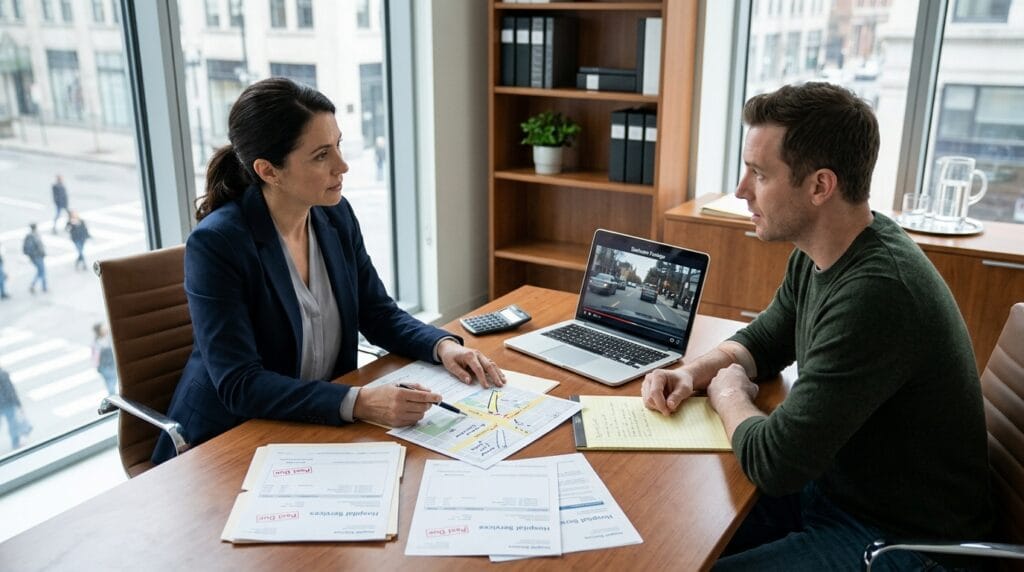
Modern crash claims often involve digital evidence. A dashcam may show the driver speeding or failing to yield. A phone record may show distraction. A vehicle event recorder may show braking and speed. A rideshare app may show trip status.
This evidence can disappear quickly. Dashcam files may overwrite. Business cameras may delete footage. Vehicle data may become harder to access after repairs. Injured people should act early to preserve anything that may help.
Your article on AI Dashcams and Digital Evidence supports this point well. Your article on Los Angeles Distracted Driving Accident Claims in 2026 also fits because many crashes involve phones, maps, and in-car screens.
Insurance Companies May Still Dispute The Claim
Even strong evidence does not stop every insurance dispute. An adjuster may argue the victim stepped out too quickly, braked too hard, changed lanes suddenly, ignored a signal, or failed to mitigate injuries.
That is why victims should avoid guessing about fault in recorded statements. They should not say they are fine if they still feel pain. They should not accept a quick settlement before understanding their medical condition.
Coverage can also become complicated. If a rideshare driver, delivery driver, uninsured driver, or low-limit policy is involved, the claim may need extra review. Your post on Uber and Lyft Accidents in Los Angeles can help readers understand how app status may affect coverage.
Los Angeles Vision Zero accident claims 2026 are not only about public policy. They are about real people who suffer injuries on streets that may already have known risks. Speed, visibility, road design, driver distraction, and digital evidence can all affect the outcome.
The bottom line is direct. A safer-streets program may help identify risk, but victims still need proof. They should get medical care, preserve evidence, document the scene, avoid rushed insurance statements, and review every possible source of liability before accepting blame or settlement money.
A serious Los Angeles crash can change a person’s health, income, and daily life. The claim should tell the full story, not just the insurance company’s first version of events.