
Los Angeles rain and flood accident claims in 2026 deserve increased attention as California prepares for potentially severe weather associated with the developing 2026–2027 El Niño. Heavy rainfall, standing water, reduced visibility, and damaged roads can create serious dangers for drivers throughout Los Angeles County.
On September 21, 2026, California announced emergency preparedness measures addressing possible flooding, erosion, mudslides, and debris flows. The following day, the California Department of Insurance encouraged residents to review their insurance coverage before significant storms arrive.
These warnings do not mean every part of Los Angeles will experience a major flood. However, they highlight risks that drivers should understand before traveling through streets, intersections, and freeways during severe weather.
After a collision, injured motorists often hear that rain caused the accident. Yet bad weather does not automatically excuse negligent driving. California motorists must adjust their speed, following distance, and driving behavior to match existing roadway conditions.
This guide explains how rain-related crashes happen, when another driver may be responsible, what insurance coverage may apply, and which evidence can help support an injury claim.
How Heavy Rain and Flooding Increase Accident Risks in Los Angeles
Southern California drivers may encounter long dry periods followed by sudden storms. During the first rainfall after an extended dry spell, accumulated oil, dust, and other substances can contribute to slippery pavement.
Rain also affects visibility. Water on a windshield, reflected headlights, road spray, and poor lighting can make it harder to recognize stopped vehicles, lane markings, cyclists, and pedestrians.
Water accumulation introduces additional hazards. Drivers may encounter standing water near freeway ramps, intersections, underpasses, and areas where drainage is inadequate.
The California Driver Handbook specifically advises motorists to reduce their speed on wet pavement and increase the distance between vehicles. It also warns that flooded roads can hide debris, damaged pavement, and dangerous water depth.
Understanding these hazards is important because the existence of rain does not eliminate the ordinary duty to operate a vehicle safely.
Hydroplaning and loss of vehicle control
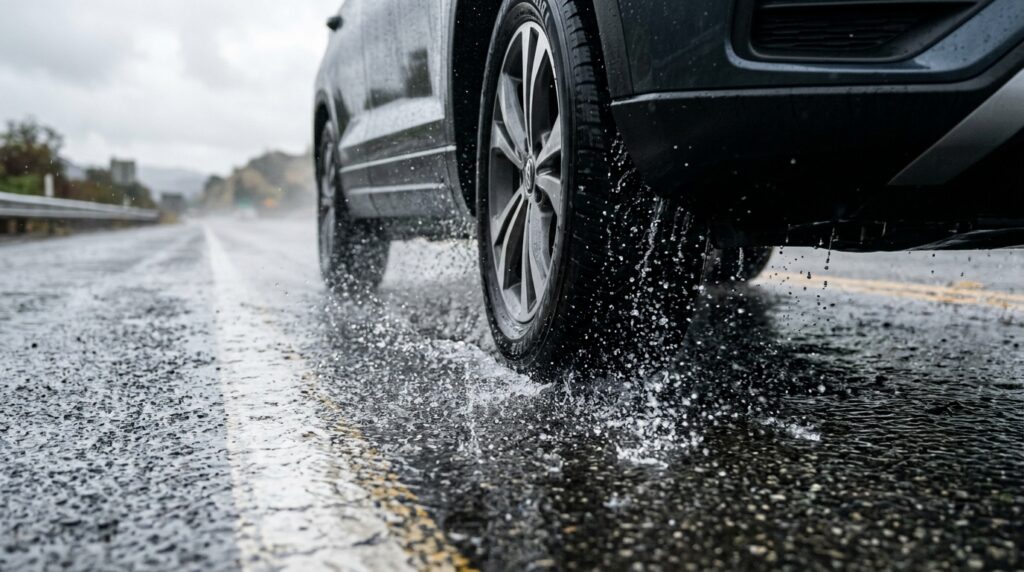
Hydroplaning occurs when water separates a vehicle’s tires from the roadway surface, reducing or eliminating normal tire contact with the pavement.
When this happens, steering and braking responses can become unpredictable. A vehicle may slide out of its lane, strike another automobile, or collide with a roadside object.
Hydroplaning risk depends on several factors, including vehicle speed, water depth, tire tread, inflation pressure, and pavement conditions.
Even relatively modest amounts of water can affect vehicle handling under unfavorable circumstances. Drivers should not assume that a freeway remains safe at the posted speed limit simply because traffic is moving quickly.
Investigators evaluating a hydroplaning accident may examine tire condition, vehicle maintenance, speed, witness statements, and whether the driver responded reasonably to visible weather hazards.
Why driving at the speed limit may still be unsafe
California Vehicle Code Section 22350 establishes the state’s basic speed law. Drivers must not travel faster than is reasonable or prudent, considering weather, visibility, traffic, roadway surface, and other existing conditions.
This means a posted speed limit is not automatically a safe speed during heavy rainfall.
For example, traveling at the posted freeway limit may be unreasonable when drivers cannot clearly see vehicles ahead or when significant standing water has accumulated.
After an accident, speed analysis may involve witness accounts, physical evidence, vehicle data, and available video recordings.
Our existing article on Los Angeles speeding accident claims in 2026 explains how speed-related evidence can influence an injury investigation.
How standing water and poor drainage contribute to crashes
Standing water can conceal potholes, uneven pavement, lane markings, and debris. In severe situations, a road may become structurally damaged or partially washed away.
Drivers should never assume that water covering a roadway is shallow enough to cross safely. California emergency officials recommend turning around rather than attempting to drive through floodwater.
In some accidents, drainage design or roadway maintenance may also require investigation.
However, identifying a flooded intersection does not automatically establish government liability. California law contains specific requirements for dangerous-condition claims involving public property.
Evidence may need to establish the condition of the roadway, its connection to the crash, and whether the responsible public entity created the hazard or had legally sufficient notice of it.
Government entities may also have statutory defenses. These claims require a different analysis from ordinary negligence cases involving private drivers.
Can a driver be responsible for a rain-related collision?
Yes. Rain can contribute to an accident without becoming the sole legal cause.
A driver may be negligent if they travel too quickly for the conditions, follow another vehicle too closely, use a mobile phone, or ignore clearly visible flooding.
Consider a vehicle approaching stopped traffic during a downpour. If the driver maintains an unsafe following distance and causes a rear-end collision, the weather may explain why braking was more difficult. It does not necessarily excuse the failure to maintain adequate space.
California generally applies comparative negligence principles. If multiple parties contributed to the accident, responsibility may be allocated among them according to the evidence.
When multiple drivers share responsibility
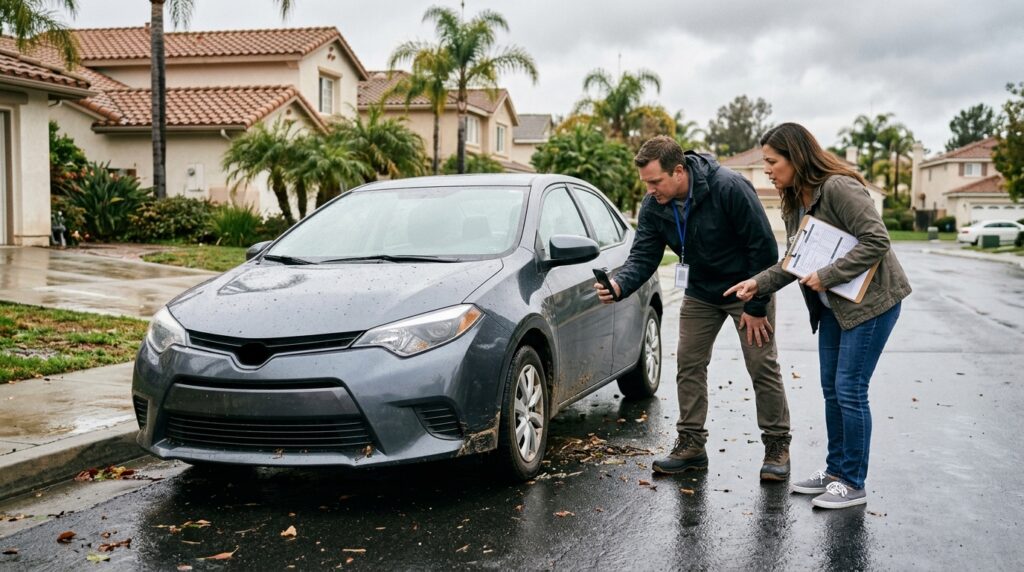
A multi-vehicle crash during heavy rain may involve several decisions that contributed to the collision.
One driver may brake abruptly, another may follow too closely, and a third may change lanes without adequate clearance.
Investigators must examine whether each action was unreasonable under the circumstances and whether it caused or contributed to the resulting injuries.
California’s comparative fault system may reduce an injured person’s recovery according to their assigned percentage of responsibility.
Nevertheless, an insurance company’s initial fault assessment is not necessarily the final legal determination. Statements should be compared with physical evidence, witness accounts, and applicable traffic rules.
Insurance Coverage and Evidence After a Los Angeles Rain-Related Accident
Rain-related claims can involve different types of insurance depending on what actually caused the damage.
If another driver negligently collides with your vehicle, that driver’s liability insurance may apply. If your parked vehicle is damaged by rising floodwater, the claim may involve your own comprehensive insurance instead.
The distinction becomes especially important when a storm causes both collision damage and unrelated water damage.
California’s September 2026 insurance advisory reminded motorists that comprehensive automobile coverage may protect against flooding, falling trees, and other storm-related events.
Comprehensive coverage is generally optional and is separate from the liability insurance required to operate a vehicle in California.
Therefore, drivers should review their policy declarations rather than assume every form of storm damage is covered.
What evidence matters in a wet-weather accident claim?
Evidence should document both the crash and the surrounding weather conditions.
Useful photographs may show vehicle damage, standing water, tire marks, roadway debris, traffic signals, and visibility conditions.
Dashcam footage can be particularly valuable. Video may show when another driver braked, how rapidly traffic was moving, and whether water affected vehicle control.
Nearby businesses may also have surveillance recordings. However, these recordings may be overwritten, making early identification and preservation important.
Official weather records and traffic alerts may help establish what conditions existed near the time of the collision.
Investigators should distinguish general weather reports from actual conditions at the crash location. Rainfall measurements several miles away may not accurately represent the amount of water covering a particular street.
In accidents involving advanced driver-assistance systems or automated vehicles, additional digital evidence may exist.
Our guide to Los Angeles robotaxi accident claims discusses how vehicle data and system records can affect crash investigations.
Medical records and insurance documentation
Medical documentation plays a central role in injury claims. An accident may cause fractures, head injuries, neck pain, back injuries, or other conditions requiring examination and treatment.
Symptoms are not always immediately obvious. A person may initially feel capable of walking away from a collision but later experience significant pain or neurological symptoms.
Seek appropriate medical care and follow treatment recommendations. Serious head injury symptoms, difficulty breathing, weakness, or loss of consciousness require urgent attention.
Keep copies of medical records, treatment expenses, prescriptions, rehabilitation information, and work restrictions.
These materials may help establish both the nature of the injuries and their consequences.
Financial documentation can include lost wages, vehicle repair estimates, transportation expenses, and other accident-related losses.
Insurance coverage must also be reviewed carefully. Collision coverage, comprehensive coverage, liability insurance, and uninsured or underinsured motorist protection serve different purposes.
A driver’s available insurance limit does not automatically determine the full value of an injury claim.
California’s minimum automobile liability limits increased in 2025 to $30,000 per injured person, $60,000 per accident involving multiple injured people, and $15,000 for property damage.
Those limits may be insufficient when serious injuries occur, making the identification of additional applicable coverage particularly important.
limitations
If a public roadway condition may have contributed to the crash, deadlines deserve special attention.
California Government Code Section 911.2 generally requires a public-entity claim concerning personal injury to be presented within six months after accrual.
This differs from the general two-year limitations period applicable to many California personal injury lawsuits under Code of Civil Procedure Section 335.1.
Exceptions and additional procedural rules may affect individual cases, so accident victims should not assume every deadline is the same.
For an authoritative resource covering wet roads, hydroplaning, and flooded highways, review the California DMV Driver Handbook’s safe driving guidance.
Drivers can reduce risks by inspecting tire tread, checking windshield wipers, maintaining appropriate following distance, and slowing before entering areas with standing water.
Headlights should be used appropriately, and unnecessary driving during severe storms should be avoided whenever possible.
When an official warning indicates that a roadway is flooded or closed, follow the instructions and choose an alternative route.
The potential El Niño conditions anticipated for 2026 and 2027 make preparation particularly relevant for Los Angeles motorists.
However, severe weather warnings should not be confused with confirmed predictions that a specific neighborhood will flood or that a particular accident will occur.
After a collision, the most useful approach is to separate the weather conditions from the conduct of each involved party. Investigators must evaluate speed, vehicle maintenance, visibility, roadway conditions, and available evidence.
Los Angeles rain and flood accident claims in 2026 demonstrate why environmental conditions and human decisions must be considered together.
Understanding these issues can help drivers take preventive measures and make more informed decisions when pursuing insurance coverage or documenting an injury.
Disclaimer: This article provides general educational information and does not constitute legal advice. Liability, insurance coverage, filing deadlines, and potential recovery depend on the specific facts and applicable California law.